Showing posts with label ford. Show all posts

Saturday, June 19, 2010

Luxury Cars 2010 | The 2010 Ford Mustang


Like previous model years, the 2010 Ford Mustang ranges from inexpensive and unrefined, to moderately expensive and highly refined. Basic V-6 models remain largely untouched and still offer a stiff ride with a less than ideal steering system. High-end models are more reminiscent of luxury cars, except that they are still noticeably pony cars with a lot of power. Basic models are great for consumers looking to break into the performance car market without spending a lot of money, while high-end models will impress even the toughest critics.

2010 Ford Mustang cars have been revamped both outside and in. Larger wheels are the standard on all models, with more power for GT models, the addition of stability control as standard options on all models as well. Though still unrefined, handling has been improved slightly in basic models, and handling changes are very noticeable with GT models. High-end GT packages have a new suspension system that was originally made for the discontinued Bullit engines of the '09 season.

Engines available still include the aging V-6 4.0 liter engine, which although it is getting old, still puts out an amazing amount of power. Basic models are equipped with the V-6 and it starts at a much lower price than V-8 equipped models. Compared with the lower models from the re-introduced Chevy Camaro, consumers may find that all around quality is lacking in Ford's base models. Where the V-6 cars excel however is body styling and interior quality. Not just high end models benefit from the complete overhaul given to these pony cars.

GT models are the only logical choice for consumers who can afford and want a true luxury style powerhouse. The available V-8 engine with an additional 15 horsepower compared with the previous season. The enhanced suspension tuning has meant that the car is even more fun for drivers. Compared with it's closest competitor, the Chevy Camaro SS, the 2010 Ford Mustang is slightly smaller and a lot more nimble. Even the Dodge Challenger can't offer the responsive handling that the original pony car easily puts out.

Each engine is offered with two different trim packages. There is the V-6, V-6 premium, GT, and GT premium. Basic models come with a few accessories, with a CD player and full power accessories offered on the premium edition. GT models come with a great choice of interior upholstery and dashboard styling. GT premiums offer just every luxury a consumer could want, and the price tag certainly doesn't let them forget it.

Safety ratings are very impressive as well. Both side and frontal tests show that the Mustang is perfect in each category. The front side airbags and standard stability control certainly make this a much safer vehicle than previous model years. The addition of 4 wheel anti lock disc brakes also only adds to the safety offered to drivers and passengers. Fuel economy ranges from 16 mpg city to 24 mpg highway. Of course the smaller V-6 gets the best numbers, while high end models equipped with a V-8 get less.

The overhauled 2010 Ford Mustang is still an eye catching pony car that offers a lot of power. Fortunately, Ford has decided to offer a lot more performance capabilities with that power in the form of much needed suspension updates. Perhaps the best part of these cars is that they truly offer something for everybody. Consumers on a budget can own a performance model, and those who want only the best can get their own model of Mustang. Expect the 'Stang to remain the most popular American pony car.

Dan Legal is a member of the web team that runs the website LemonFree.com Cars. LemonFree is a car search engine which currently over 1.8 million new and used cars for sale.

If your interested in purchasing a 2010 Ford Mustang; give LemonFree a test drive today!

Article Source: http://EzineArticles.com/?expert=Daniel_Legal

Luxury Cars 2010 | New Ford Cars - New Car Technology For the Luxury Car Market

Ford as we know today was founded in 1903 by Henry Ford. Back then, it was his dream to build a car for the masses. Today, his legacy stands as the man that made cars a crucial part of our mobile lifestyle.

In his early years, Ford introduced the 'moving assembly line'. This was the first time that a manufacturing company employed moving assembly lines to achieve a more cost-effective method of production.

Later on, Ford expanded into the luxury-car market when he bought Lincoln Motor Company in 1925. Since then, Ford grew to become one of the largest car manufacturers across the world. The Ford Focus, Ford Fusion, Ford Mustang and Ford Fiesta are some of the popular models of Ford cars in the international market.

Ford Motors also has a number of car models rolled up in the market that include a segment of luxury cars as well. Recently, they have developed a new technology known as Noise Vision technology that ensures the quietest interior cabins.

Noise vision Technology:

Noise vision Technology is a new technology which helps manufacturers identify unwanted sounds and eliminate them.

This new technology will make sure that all new cars from Ford Motors will have the quietest interior cabins.

The 'Noise Vision' is basically a small sphere placed inside the cabin of the car and is equipped with more than thirty highly sensitive microphones and twelve special cameras.

The software used in the Noise Vision reads data and creates a computerized image that shows interior noise "hot spots," including wind noise, a squeak, a rattle or unwanted feedback from engine.

New Luxury Ford Cars for the 2010 model year will be developed with this technology.

2010 Taurus, the Fusion, the Flex and the F-150 are some of the names of the cars from Ford that ensure a quiet interior.

Ford Motors work hard to provide comfortable cars to the masses, blended with latest technology. This technology in Ford cars will give tough competition to other manufacturing companies, as Ford is going to use this technology up to a great extent in the luxury car segment.

For any help on ford cars, check out the info available online; these will help you learn to find the ford used cars!

Article Source: http://EzineArticles.com/?expert=Methew_Alyx

Saturday, May 29, 2010

2011 Ford Mondeo coming with 2.0L Ecoboost

2011 Ford Mondeo


The Ford Mondeo is due for a mid-cycle refresh for the 2011 model year and all signs point to a debut at the Paris Motor Show this September. But ahead of its big reveal, spy photographers have caught the new Mondeo out in the open, and while the basic shape hasn't changed, there's something far more interesting under the hood.

The major stylistic upgrades are up front, where the Mondeo's fascia picks up a few cues from the Fiesta and the 2012 Focus, including a larger lower grille and slimmer upper section. The front foglamps have been re-shaped and a strip of LED running lamps tie the design into Ford's B-segment hatch.

At the back, the tailgate gets a subtle re-shaping above the license plate pocket and it appears the lights have been modified under the camo tape. The most important changes will be in the engine compartment, where the Mondeo will get the new 2.0-liter Ecoboost inline-four and the Powershift dual-clutch transmission. Expect all the details to be revealed shortly ahead of the Paris show this fall.


[Source: Secret New Cars]

Friday, May 14, 2010

FORD MUSTANG GT 2011 PICTURE


FORD MUSTANG GT 2011 PICTURE


FORD MUSTANG GT 2011 WALLPAPER
FORD MUSTANG GT 2011 PICTURE


FORD MUSTANG GT 2011 PICTURE
FORD MUSTANG GT 2011 DESKTOP

Wednesday, April 28, 2010

Beijing 2010: Ford Start concept

Ford Start Concept

As we were checking out the new Ford Start concept at the Beijing Motor Show, we ran into the head of Ford's advanced studio in California, Freeman Thomas, and the mini car's lead exterior designer, Jeff Nield.

According to Nield, he wanted to create a vehicle that retained elements of Ford's "Kinetic Design" language while at the same time create something more subdued, able to stand apart from the noise surrounding the show. Thus the Start has a cleaner simpler shape that's slightly more serious than past concepts. Nield mentioned the Mini and how it's always had a cute, happy demeanor about it. He wanted to create something different – a thing of beauty injected with very natural, organic elements.

Thomas explained that the designers wanted to experiment with a hybrid construction consisting of a mix of aluminum, high strenght steel and composites. This allowed the creation of a very open, airy cockpit, with thin pillars for good visibility, while also providing occupants a feeling of safety with the high belt line.

One of the more interesting interior details is the monorail front seat tracks that have the thrones on a central pedestal, thus increasing foot room for rear passengers. There are no production plans for any of this right now, but some of the ideas could shine a light on where to go next – and that turbocharged 1.0-liter three-cylinder is definitely finding its way to market.

Wednesday, April 21, 2010

Why It's Not Coming Here: VW Amarok priced at $35k in Europe

Volkswagen Amarok


One of the last details concerning the Volkswagen Amarok, its price in euros, has been filled in: €26,203, or $35,260 U.S. in the ever misleading straight-up conversion from euros to dollars. Subtracting the 19 percent duty folded into that price in Germany, you're still left spending €21,224, or $28,555 U.S. That's what you call "Holy smokes!"

If we want to make the admittedly difficult attempt to put some context around that without diving into European taxes and price structures, let's take the Golf. The most basic two-door version is €16,650, or $22,399 U.S. Subtract that 19 percent duty and you're at €13,487, which is $18,144. That matches up quite nicely with the U.S. price for the base two-door model: $17,620.

Back to that bog-standard Amarok – at $28,555, you're just a grand short of a Ford F-150 XL Super Cab, which decimates the 122-horsepower Amarok in everything but gas mileage. By the time you get to the Amarok in Highline trim, you're up to 163 hp and you've added four-wheel-drive, but you've also got a €37,169 ($50,022 U.S.) bill before taxes and fees. And that, ladies and gentlemen, is why there will be zero VW Amaroks sold in these fifty states. For the rest of you, start saving.


[Source: PickupTrucks.com]

Tuesday, April 6, 2010

Ford Focus RS500 already sold out?

2011 Ford Focus RS500


Well, that didn't take long, did it? We knew the new 2011 Ford Focus RS500 would move fast, but not quite this fast. Powered by a 2.5-liter five-cylinder that produces 345 horsepower and 339 pound-feet of torque, Ford's hottest hatch one-ups even the already bonkers Focus RS with its piddly 305 horsepower and 325 lb-ft. Considering that the RS is capable of a 0-62 mile per hour sprint of under six seconds and a top speed of 163 mph, the RS500 should clock in around 5.6 seconds.

What we didn't expect was the fact that the RS500 would sell so quickly. With their matte black paint, 19-inch wheels and all that performance on tap, we certainly expected them to be a hot commodity, but if Autocar is to be believed, the whole run of 500 units has already sold out – some 12 hours after the reveal. Sales will be spread out over 20 European markets, with the UK getting 101 units, Germany getting 55 cars, France receiving 50 and Belgium scoring 50 units, with Denmark, the Czech Republic and Greece getting five units each, while Ireland receives three.

The best part of the story is the fact that all 500 units are already spoken for, even before prices have been announced. Ford is said to be sorting through the letters of intent from customers to figure out dealer allocations. And don't forget, the order books don't formally open until May. With the regular RS trading above sticker on the used car market, we're guessing there will be more than a few flippers in the initial owner group.

Thursday, April 1, 2010

Ford Focus 2010


Ford Focus 2010
Ford Focus 2010
Ford Focus 2010 Car
Ford Focus 2010
Ford Focus 2010 Images
Ford Focus 2010
Ford Focus 2010 Wallpapers
Ford Focus 2010

Tuesday, March 30, 2010

Ford Focus RS

Ford Focus RS500


A limited edition 500 unit run of the Focus RS called the Focus RS500 will be unveiled to the public for the first time at the 2010 Leipzig Motor Show in Germany on April 9 next month. Each car will have its own serial number and only 101 of them will be available in UK, with the rest scattered around the car’s other markets.


No, the RS500 name doesn’t mean the car makes 500 horsepower, but as you can already guess from the first paragraph it denotes the production run. The 350 PS that the Focus RS500 makes is about 45 PS higher than what the normal Focus RS produces. This is accompanied by 460Nm of torque between 2,500rpm to 4,500rpm, which is up from the 440Nm of the normal Focus RS.


Ford Focus RS500


The engine is the same 2.5 liter Duratec RS but has had some massaging including a larger air-to-air intercooler to deliver a cooler, denser charge; a larger air filter box for increased airflow; larger diameter exhaust downpipe; and an uprated fuel pump, along with an updated software calibration to optimise the performance of the revised engine. 0 to 100km/h takes 5.6 seconds.


“The engine’s improved breathing has allowed us to increase power without having to raise turbo boost pressure significantly. This has made it possible to enhance peak performance while maintaining the excellent driveability, fuel consumption and emissions of the standard Focus RS,” said Gunnar Hermann, Ford’s global C-car vehicle line director. The modifications from the engine have been done by a team of engineers from Ford TeamRS in partnership with Revolve Technologies, the automotive engineering firm which develops Ford approved performance upgrades through its Mountune brand.


Ford Focus RS500


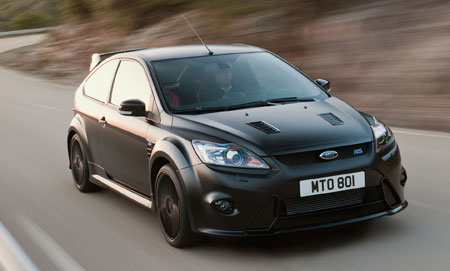
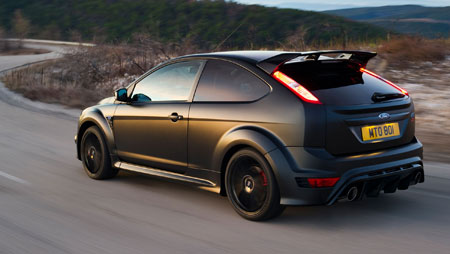
And of course as you can see from the photos, the RS500 has a special matte black finish combined with matching metallic black alloy wheels, glossy black finish on the trapezoidal lower front grille and splitter, twin-blade rear spoiler and the rear venture. But the thing is, the matte black is NOT paint.


The RS500 cars are painted in a standard Panther Black metallic colour, before being shipped to a dedicated 3M facility near Frankfurt, Germany, where a special foil film will be applied to the bodywork to create the matt black effect. In the event of damage to the bodywork, Ford dealers will be fully supported by a Europe-wide network of 3M agents who can replace the film on the affected panels. The film is designed to be resistant to superficial marks and scratches.

Wednesday, March 24, 2010

Review: 2010 Ford Shelby GT500

2010 Ford Shelby GT500


We know what you're thinking. Isn't it a little late to be reviewing the 2010 Shelby GT500? After all, Ford introduced the 2011 version with the new aluminum block at last month's Chicago Auto Show. It's not that we didn't want to get our hands on the 2010 GT500 before now. In fact, we were champing at the bit to review one a few days after our First Drive, but apparently the universe didn't want us to have one until now.

Last summer, a few issues delayed our chance at driving Ford's hottest 'Stang, beginning with Ford running out of tires for the GT500s in the press fleet (we can't imagine why). When Fall rolled around, the transmission in our tester was damaged the week before we were scheduled to take delivery. We were ready to give up hope when the call came in that it would be available in March. Better late than never, right? Besides, who's going to turn down a week with a 540-horsepower muscle car? Al Gore? Definitely not us.

To be honest, our expectations couldn't have been higher. Our last encounter with the 2010 GT500 at Infineon Raceway allowed us to let loose on the 1/4-mile drag strip and smooth pavement of the road course, the perfect playgrounds for a high-horsepower Mustang laden with its infamous solid rear axle. It was essentially on par with the $80,000 GT500KR, but cost $30,000 less and came without Shelby's controversial carbon fiber hood, which we could do without anyway. After a day's worth of fruitful flogging, we were ready to sign the check. But would the GT500 be a less likable character off-track? Could a 540-horsepower Mustang suit our daily requirements of equal parts grocery-getting and canyon-carving?

Visually, the GT500 benefits from the 2010 redesign more so than the standard Mustang V6 and GT models. The rear end, especially the taillights, doesn't look quite as awkward thanks to the subtle spoiler, and the front end takes on a slightly more aggressive appearance with its protruding snout. We're also particularly fond of the new 19-inch wheels, which appear more upscale compared to the previous 18-inch rollers. The plastic front spoiler and rear diffuser come across as bargain-basement pieces, but that might not be such a bad thing. We didn't have any problems making it over some steep dips in the road, but the car arrived with a slightly damaged lip, likely the result of a tall curb in a parking lot. It didn't take long for us to realize that parking the GT500 is more challenging that it would appear, as it's nearly impossible to judge exactly where the massive front end is when pulling forward. If that part of the coupe is going to take some fairly frequent abuse, then we would rather have the parts be as inexpensive as possible.

While the exterior is arguably more attractive than its predecessor, the interior is – without question – vastly improved compared to the previous GT500. Like the Mustang GT and V6, the GT500 benefits from a complete cockpit makeover, with higher quality materials and a more modern look. Soft-touch plastics abound, finally making occupants feel like they might actually be piloting a $50,000 car. And yes, that's real aluminum on the dash. Ford has also added a few thoughtful touches including Alcantara trim on the steering wheel, seats and shifter boot, and we also appreciate the new gauges that somehow look more modern while still retaining a retro look. The matching stripes on the seats and cue ball shifter might be too cheesy for some, but in a car like the GT500, it comes off as cool and clean.


Our test car also came with the Electronics Package that includes the navigation system and dual climate control, a $2,195 option. You'll have to forgive us for not using the SIRIUS Travel Link or the 10-gigs worth of music storage (we already know they're good), but those features weren't our primary focus while we were at the helm. We're sure you understand.

Visuals aside, the GT500 is all about the powertrain. The iron block, supercharged 5.4-liter V8 remains in the car for 2010, although it's rated at 540 horsepower thanks to its open-element air intake and engine management changes. That KR-matching horsepower, plus 510 pound-feet of torque, is channeled through a new twin-disc clutch and six-speed manual with revised gearing. Though Ford has given the GT500 a more aggressive final drive ratio (3.55:1 compared to 3.31:1), both fifth and sixth gear are now taller to provide better fuel mileage on the freeway. That doesn't sound important, but it actually drops the price of the GT500 by $300 thanks to a reduction in the gas guzzler tax. At 65 mph we could doddle along at a mere 1,500 rpm in sixth gear, which contributed to our average of 19.5 mpg overall. Not bad for a 540-hp beast.


Like the engine, the suspension has been improved thanks to knowledge gained through the GT500KR program. The front springs are 13 percent stiffer in front and seven percent stiffer at the rear, and the dampers have been tweaked to provide better control. Steering has also been improved thanks to a softer anti-roll bar and a stiffer steering shaft that reduces input effort.

All of those changes might seem minor, but they add up to a drastically better car than prior model years. While the rush of driving the previous generation GT500 quickly dwindled because of its many deficiencies, there's nothing to impede the driving experience of the new car. The steering is precise, requiring little effort at first and building up feedback as you increase speed. Assuming you haven't overloaded the front tires before going into a corner, the front end goes exactly where you point it despite the mass of iron over the front wheels. The clutch, previously vague and unforgiving, is buttery smooth and just as capable of doing hard launches as it is inching along in traffic. And the shifter, originally one of our biggest complaints in the last GT500, has lost its rubbery feel and provides accurate shifts. It requires a firm grip and a decent amount of effort to row between gears, but we'd almost be disappointed if it were too easy.


We tried to take the GT500 on as many types of roads as possible, and the results were fairly predictable. Long, smooth sweepers suit the car best, providing an easy task for the suspension and allowing the engine to really stretch its legs. The GT500 can even tackle tight turns with surprising agility, swinging the front end around with relative ease. The solid rear axle only lets itself be known over large bumps encountered mid-turn, causing the back end to step out, albeit in a fairly predictable manner that only takes a fraction of a second to correct.

Where the GT500 didn't shine was on the freeways of Southern California. The suspension tuning seemed to harmonize exactly with the repeated bumps in the road, the shocks decompressing exactly as we thudded over the next imperfection in the road. The result of bouncing up and down in our seats in a consistent rhythm over several miles quickly became tiresome.


The GT500's favorite type of road, however, is the one that is very straight, very long and very deserted. These can't be found in abundance near downtown Los Angeles, but we endured a bumpy freeway drive to get out of the city proper, and after all, we needed to test out the new three-stage traction control system. Extensively.

With the traction control fully disabled, which requires holding the TC button for a full eight seconds, the GT500 turns into the world's best burnout machine. Rev the supercharged V8 to practically any RPM, drop the clutch and in a matter of seconds the rear tires will be engulfed in massive clouds of scorched rubber while the engine bangs off redline. Shift to second and the mayhem continues. Only in third gear does the GT500 finally start to gain traction at full throttle, and at that point you'll have already breached the limit of legal speeds. If smoky burnouts are your thing, then feel free to leave the traction control off, but if you're trying to actually go somewhere in a hurry then dial the TC to Sport mode. It allows a small amount of wheel spin before cutting power, and although it still requires a delicate foot to work the throttle, provides a longer leash for tire spin than with the traction control fully on. Once hooked up the GT500 isn't necessarily the fastest car we've driven, but thanks to an insanely flat torque curve it can pull hard from just about any rpm.


But as much as we like the 2010 GT500, it's not a car we would buy. That's not to say we aren't smitten – we're just as in love as we were when we left Infineon Raceway – but we just can't recommend it. It's not the price tag ($46,325 MSRP, $50,895 as-tested), which is an incredible bargain. Nor is it the solid rear axle (negated by Ford's impressive suspension tuning). It's certainly not the interior, or the exterior for that matter.

You see, as good as the 2010 GT500 is, there's something better coming. Just like we would have never bought a 2010 Mustang GT in anticipation of the legendary 5.0-liter V8 arriving in the 2011 model, we would keep our wallet tucked away until the 2011 Shelby GT500 hits showroom floors. With its aluminum block V8 filling the space between the front fenders, the 2011 GT500 should be even better. That's what taking 105 pounds off the front end of a car will do. So be patient, and wait for the 2011 GT500. That's what we're doing.

[Source: Autoblog]

Sunday, March 21, 2010

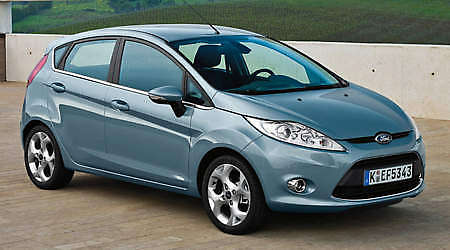
Ford Fiesta in M’sia – preliminary specs unveiled!

Ford Fiesta


If you’ve not seen Ford’s B-segment contender in the metal before, a nice red-coloured hatchback body example is currently on display in Blue Concourse, Sunway Pyramid new wing this weekend starting from today. Sime Darby Auto ConneXion has also unveiled the preliminary specifications for the Fiesta 1.6 liter Sport model:


  • 1.6 liter Ti-VCT engine producing 120 PS at 6,500rpm and 152Nm of torque at 4,500rpm.

  • 6-speed automatic Ford Powershift twin clutch transmission

  • Dual SRS airbags

  • Electronic Stability Programme with Traction Control (ESP)

  • ABS brakes with EBD


  • Sports suspension

  • 16 inch alloy wheels

  • Foglamps, rear spoiler, both sedan and hatchback bodies

  • Electric Power Steering

  • Audio system with USB connectivity

  • Fabric seats


The specs list sounds really impressive, as most B-segment cars don’t even have ESP stability control as an option worldwide! The Fiesta’s available option list has benefited from it being a mainstream player in Europe, where safety features such as a good amount of airbags as well as stability control are a must have to gain public acceptance. But in the end it’s up to the Sime Darby product planners to tick the relevant boxes and it looks like they did! It’s very good to hear that finally a mainstream B-segment vehicle will be available here with ESP.


The preview leaflet that’s being handed out during the Fiesta preview at Sunway Pyramid (you can find a copy after the jump) also indicates the availabiity of a 1.4 liter Duratec with a 5-speed manual, but no specs available for that model. What I’m most curious about is how much the new Fiesta models will be priced at, and how will it compare both price and specifications wise with its ’sibling’, the Mazda 2.


With the 6-speed Powershift twin clutch transmission, the Fiesta already has an edge over the Mazda 2 which makes do with a regular automatic transmission. The Fiesta’s engines are also larger and more powerful than the Mazda 2’s – we’re taking about a 1.4 and a 1.6 for the Fiesta versus a 1.3 and a 1.5 for the Mazda 2.


It’s definitely a very exciting year for the Ford brand in Malaysia, which will soon have a fresh and new line-up consisting of cars like this new Fiesta, both diesel-powered and regular petrol Focus, the Ford Mondeo and the Ford S-MAX MPV!

Friday, February 12, 2010

Top Luxury Cars - The Ford F150 Raptor


Parts availability for the Ford F150 Raptor is going to be like an explosion. As soon as this SVT truck hits the streets there is going to be everybody and his brother looking for parts. I have been on the phone looking for parts manufacturing company's that is or is going to be manufacturing even the tiniest of Raptor parts. There are a few areas the Raptor that can be upgraded right off the bat. Parts like tires, wheels and brakes can be upgraded with parts available in the currant after market parts that should fit the Raptor now. We can add parts such as larger calipers, better wheels with bead locks, we can add bed covers, BAK is the supplying vendor for bed covers for the factory F150's have bed covers that will fit. there are lots of parts that can be used to personalize your new F150 Raptor. Though there not allot of parts manufactures working on performance parts up grades for the Raptor due to the cost of R&D and the decline in truck sales. But I would bet you that when this Raptor hits the market there will be a great deal of catching up to do.

I've talked to Rousch Performance engineers about this very thing, Rousch is holding back because Ford made some major changes in the Raptor engine management and there currant performance parts and goodies will not work for the Raptor so its a ground up situation for there parts as well. I'm sure they will attack this with all they have once the truck is available. There is one company that is in the position to supply a performance parts upgrade that will add approx. 150 hp to the Raptor right out of the box and we will be selling that Raptor system at about the same time the truck will be available. Raptor suspension is another area that has limited upgrades. As of yet there are no companies with lift kits on the drawing board reason being Ford has major changes to the suspension and they are waiting to get there hands on the new Raptor, Shocks are an area hard pressed to see up grades, talking to Ross the lead engineer at FOX racing there are no upgrades that are being looked at because Ross designed the system that ran in the BAJA and the Raptor already has the best, maybe later we will see something. He did say that FOX has a new Raptor Style shock upgrade for the standard F150's that will up grade the F150's to a Raptor style ride, we will have that soon.

Another area that we have looked at for upgrade is the cast lower front control arms, we have a major player in upscale buggy parts manufacturing that says they can produce billet lower control arms, we will continue to work on that and keep you advised.

www.F150mania.com
Being a Ford Truck owner and lover since my first days of driving from early 1960's I have at times had problems locating and purchasing some ford truck parts, you always have to wade through dozens of sites looking for that one item that will solve your problem or dress up your truck, takes a lot of time and you don't always find what your looking for or it's wrong and wont fit!

I'm using my years of Ford experience from building my own and others trucks and cars to help you build your dream truck. with over 40 years of building engines, transmissions and just about anything else that can be done to these great trucks to provide my customers with a place that they can purchase parts from with the confidence and trust you would expect from a fellow F150 nut! stop by and check us out we want to be your parts source for your dream truck.

Thanks, Dean B.
Article Source: http://EzineArticles.com/?expert=Dean_Beard

Wednesday, February 10, 2010

Chicago 2010: Ford Transit Connect Taxi

Ford Transit Connect Taxi

Hot on the (w)heels of the Ford Transit Electric, the Transit Connect Taxi drove onto the stage at the Chicago Auto Show today running on compressed natural gas (CNG). The clean-burning utility van – based on the gasoline-powered North American Truck of the Year winner – adds to Ford's taxi fleet options like the Crown Victoria (see: pretty much any taxi in any city in the U.S.) and the Ford Escape Hybrid. The new taxi van can also burn propane (LPG, or liquefied petroleum gas). Of course, regular Transit Connect buyers can also opt for Ford's engine prep package to be able to put the gasoline alternatives into the tank. Like its battery-powered cousin, the Transit Connect Taxi will be in dealerships later this year.

Ford product development vice president Derrick Kuzak said that there is "strong demand" for CNG and LPG vehicles among fleet operators. Kuzak also highlighted the small size of the Transit Connect in an odd way: if all of the taxis in Chicago were replaced with these vans, he said, it would free up approximately four acres. Um, OK.

PRESS RELEASE

FORD TRANSIT CONNECT TAXI 'ON DUTY'; NEW PEOPLE MOVER RUNS ON GREEN FUELS WITH NEW ENGINE OPTION
  • Transit Connect Taxi goes into production and will be available for the 2011 model year
  • Transit Connect is built on a dedicated commercial vehicle platform, tested to Ford's toughest truck standards, offers a fuel-efficient 2.0-liter four-cylinder gas engine and is designed to meet the extreme demands of taxi service
  • A new engine prep package allows conversion to efficient, clean-burning compressed natural gas (CNG) or propane (LPG, or liquefied petroleum gas)
  • Transit Connect's roomy, easy-to-access interior provides passenger comfort and ample luggage storage space, even after modification to contain CNG/LPG fuel tanks
CHICAGO, Feb. 9, 2010 – The Ford Transit Connect Taxi will go into production and arrive in dealerships later this year as a 2011 model, adding to Ford Motor Company's leadership in the North American taxi market.

Making the announcement today at the Chicago Auto Show, Ford also said it will introduce engine prep packages on all Transit Connect models – base and taxi – allowing conversion to efficient, clean-burning compressed natural gas (CNG) or propane (LPG, or liquefied petroleum gas). Both CNG and LPG are popular among taxi operators because of their low cost of ownership.

The roomy, flexible interior of the Transit Connect – the 2010 North American Truck of the Year – is perfectly suited for taxi service and conversion to CNG and LPG. The vehicle's 135 cubic feet of cargo space accommodates a compressed gas tank while leaving ample passenger legroom and cargo capacity.

"While meeting with taxi operators in cities throughout the U.S., we found considerable interest for vehicles that run on alternative fuels," said Mark Fields, Ford's president of The Americas. "The Transit Connect Taxi, combined with an engine modified by Ford to use CNG/LPG, is designed to meet that need. This marks a new era in 'green' transit."

To further serve taxi operators, Ford will provide required calibration specifications for the CNG or LPG conversion. By properly following Ford's specifications, the conversion can be completed without voiding the engine's warranty.

The alternative fuel advantage
According to the U.S. Environmental Protection Agency, CNG is less expensive and burns cleaner than gasoline, resulting in 30 percent to 40 percent less greenhouse gas emissions. Propane also burns cleaner than gasoline.

"Compressed natural gas and propane offer more than sufficient power for vehicles because they are high-energy fuels," said Rob Stevens, Transit Connect chief engineer. "Another natural benefit for these fuels is they provide an overall lower emission of greenhouse gases compared to gasoline. Additionally, operating on CNG or LPG provides the operators lower fuel/operating costs for their fleet."

Furthermore, nearly 87 percent of natural gas used in the United States is domestically produced. There also are government tax credit incentives for fleets to convert to alternative fuels.

Since October 2009, CNG prep packages have been available on E-Series vans with 5.4-liter and 6.8-liter gas engines.


A conversion-ready interior
The Transit Connect Taxi offers an outstanding interior package for people and cargo. With its open architecture, the taxi provides excellent interior headroom and passenger visibility. The vehicle's rear seat has been moved back three inches to maximize passenger comfort. Plus, with 6.5 inches of ground clearance, passengers step easily through the dual sliding doors. Additional climate control ventilation has been added for rear seat passengers.

The Transit Connect Taxi also features a wiring upfit package with a hole in the roof for signage, vinyl front and rear seats, rubber rear floor, sliding second-row windows and standard third-row windows – all of which are factory installed. Additional installation of technology and other taxi modifications such as roof signage and the optional seating partition are handled by taxi upfitters in local markets.

The vehicle's cargo area easily accommodates compressed natural gas tanks directly behind the second-row seat, still allowing ample luggage storage.

Technology on the go
Ford is collaborating with Creative Mobile Technologies, LLC (CMT), to integrate premier payment processing and passenger information technologies in the Transit Connect Taxi.

Ford and CMT also are developing strategies for potential integration of Ford Work Solutions, a suite of productivity technologies for business owners providing a wireless in-dash computer with full high-speed Internet access and navigation.
Evidence of how this technology could work in the future is included in the Transit Connect Taxi. It also features an 8.4-inch electronic infotainment and navigation screen that shows cab fare, news, weather, sports scores and stock ticker. With the touch screen, passengers also can select their choice of programming, follow the taxi's journey on a map, or scroll through a list of points of interest along the route – including restaurants, museums and shops.

"Ford has demonstrated a significant commitment to support the taxi industry with not only a dedicated product but also with the commitment to work with the technology companies that support the industry," said Jason Poliner, chief operating officer, CMT. "Ford understands that the taxi business is not just the vehicle but a complete technological solution."

Once at the destination, the screen displays the fare with options to pay via cash, credit or debit. Cardholders can swipe their card, select a pre-calculated tip recommendation or utilize the touch screen to enter a tip amount, and complete the transaction right from their seat.

Building on taxi leadership
The "green" taxi isn't new at Ford, which has been a leader in the taxi business for decades. Ford was the first manufacturer to introduce gas-electric hybrid-powered taxis into North American fleets with the launch of the Ford Escape Hybrid in San Francisco and New York City in early 2005.

Built on a dedicated commercial vehicle platform and tested to Ford tough truck standards, the Transit Connect Taxi – including gasoline-powered versions and those modified to operate on CNG/LPG – is designed to meet the extreme demands of taxi service.

With its standard 2.0-liter, four-cylinder engine and automatic transmission, the conventionally powered Transit Connect is expected to deliver an estimated 30 percent improvement in fuel economy over many of today's traditional taxis.

"Transit Connect already has proven that it offers tremendous versatility for commercial fleet use," said Gerry Koss, Ford fleet marketing manager. "The Transit Connect taxi, combined with the capability for CNG/LPG conversion, further demonstrates its flexibility."

###

About Ford Motor Company
Ford Motor Company, a global automotive industry leader based in Dearborn, Mich., manufactures or distributes automobiles across six continents. With about 198,000 employees and about 90 plants worldwide, the company' s automotive brands include Ford, Lincoln, Mercury and Volvo. The company provides financial services through Ford Motor Credit Company. For more information regarding Ford's products, please visit www.ford.com
.

Chicago 2010: Ford Transit Connect Electric

Ford Transit Connect Electric

As expected, Ford brought the latest (and greatest?) incarnations of the Transit Connect utility van to the Chicago Auto Show today. The battery-powered Transit Connect Electric was up first, perhaps because it fits so well into Ford's strategy of vehicle electrification (see also: Focus Electric coming next year, followed by a plug-in hybrid and a next-gen hybrid in 2012). At the very least, this is Ford's first battery-powered vehicle, said product development vice president Derrick Kuzak.

The practical and battery-powered delivery van (the standard version was named the North American Truck of the Year this year) uses a powertrain developed with help from Azure Dynamics Corporation. Called Force Drive, the 55 kW system uses a 28 kWh lithium ion battery pack from Johnson Controls-Saft, has a 75 mile per hour top speed and can drive up to 80 miles on a charge. Will these specs be enough for customers? Praveen Cherian, program manager for the Transit Connect Electric, said in a statement that:
We're excited about the potential for our electrified vehicles. People were a little hesitant about hybrid technology at first, but now they accept it and embrace it. We expect the same will be true of electric vehicles.
[Source: Ford]

Chicago 2010: New Ford Edge becomes cutting edge CUV

2011 Ford Edge Sport

Ford rolled out its 2011 Edge, with a triad of engine choices, in Chicago this morning. As we mentioned earlier, the 2011 variant will offer the all-new EcoBoost 2.0-liter four-cylinder engine. The four-cylinder turbo, with direct-injection, promises 20-percent better fuel economy without sacrificing performance or suffering emission penalties (Ford has yet to release any specifics on horsepower, torque or fuel economy). The standard engine will be a 3.5-liter V6 (285 horsepower and 253 lb-ft of torque), while the Edge Sport (pictured above) is fitted with a 3.7-liter Ti-VCT V6 (305 horsepower and 280 lb-ft of torque).

The front fascia is completely reworked with a new fresh look, while the rear is only slightly updated – the greenhouse appears untouched. Mechanically, the brake system has been upgraded with larger rear rotors, improved pad composition and a revised brake booster. The Edge SEL and Edge Limited wear standard 18-inch tires – now one-half inch wider, with 20-inch tires optional on both. The Edge Sport has (gulp!) 22-inch wheels standard, a class-exclusive says Ford.

Inside, the dashboard has been completely redesigned around the centerpiece MyFord Touch infotainment center. Standard on the Edge Limited and Edge Sport, the system utilizes a 8.0-inch full-color touch-sensitive LCD screen in the center console. Complementing the main display is the revised instrument panel with dual multi-tasking 4.2-inch information panels on each side of the speedometer that are operated via five-way spoke-mounted thumb switches on the steering wheel. With about a gazillion different features, including the ability to have your Edge welcome you by name when you enter the vehicle, the industry-leading MyTouch system keeps getting better and better – its revised application in the 2011 Ford Edge only serves to reinforce the message.

[Source: Ford]

Top Luxury Cars - The 2010 Ford Fusion Hybrid Road Test

There's a common misconception that U.S. automakers are behind some imports in technology and fuel efficiency. That may have been true some years ago, but it could not be further from the truth today. Both Ford and GM have become quality and fuel economy leaders in the last few years, especially from the highly competitive mid-size segment up. Chrysler still trails in both but is working hard and fast to catch up. Don't believe us? Check the numbers.

The EPA estimates for the ultra-fine new Fusion and Milan Hybrids are an impressive 41 mpg city and 36 highway, which beats Toyota's '09 mid-size Camry Hybrid by eight and two mpg, respectively. They are, Ford says, the most fuel-efficient midsized sedans in America.

The conventional Fusion and Milan, nicely restyled and much improved for 2010, offer the mid-size segment's best gasoline four-cylinder fuel economy, more powerful available V-6s, class-exclusive technologies, including blind spot detection and warning with cross traffic alert and Ford SYNC, and more total passenger and luggage capacity than the Camry. The Fusion's new look is more upscale, sportier and aerodynamically slicker. But the most exciting news is this all-new Fusion Hybrid. Together with its Mercury Milan Hybrid counterpart, it joins the Ford Escape and Mercury Mariner (compact SUV) Hybrids to double both the size and volume of Ford Motor Co.'s hybrid lineup.

Among this next-generation system's key features are an ultra-efficient new 2.5-liter four-cylinder "Atkinson cycle" engine good for 155 hp and 136 lb.-ft. of torque mated to an electronically-controlled continuously variable transmission, or "e-CVT." Intake Variable Cam Timing (iVCT), enable seamless transitions from gas to electric and vice-versa, while both spark and cam timing are varied according to engine load to optimize efficiency and emissions. Enhanced electronic throttle control reduces airflow on shutdowns, which reduces fuel need on restarts, and a "wide-band lambda sensor" analyzes air-fuel ratios and adjusts the lean/rich mixture to keep the system in balance and minimize emissions.

The new 275-volt nickel-metal hydride (NiMH) battery is smaller, lighter and optimized to produce 20 percent more power. Cooled by cabin air, its improved chemistry allows it to run at higher temperatures, and an added variable voltage converter boosts voltage to the battery to operate the motor and generator more efficiently. A "smarter" climate control system with an electric air-conditioning compressor minimizes engine usage by running it only as needed for heating and cooling.

The brake system delivers full regenerative braking (when the drive motor becomes a generator), backed up by friction braking as needed, to capture nearly 94 percent of the energy normally lost through friction in braking and send it back to the battery. And, as we noticed during our drive, it delivers improved brake pedal feel compared to the previous system.

The hybrid system also allows the Fusion and Milan Hybrids to operate longer at higher speeds in electric mode than competitive systems. They can run up to 47 mph in pure electric mode, approximately double the speed of some competitors. "Because our hybrid can run at a much higher speed in electric mode, you can do so much more in city-driving situations," says Ford Hybrid Applications Manager Gil Portalatin. "Under the right conditions, you can drive in your neighborhood or in mall parking lots without using a drop of gasoline." With the 41 city and 36 hwy ratings, Fusion and Milan Hybrids can achieve a driving range of over 700 miles on a single tank of gas.

It uses two high-resolution, full-color liquid crystal display (LCD) screens flanking the speedometer that can be configured to show different levels of information. The approach is multi-layered: A tutorial mode helps drivers learn about its instruments and the system, while tech enthusiasts will enjoy detailed gauges that help them become more efficient. The system even "grows" vines and leaves on-screen to reward efficient driving.

Drivers can choose one of four data screens: The basic "Inform" screen displays fuel level and battery charge status; "Enlighten" adds an electric vehicle mode indicator and a tachometer; "Engage" adds engine output power and battery output power; and "Empower" adds power to wheels, EV power threshold and accessory power consumption. All levels can show instant fuel economy, fuel economy history, odometer, engine coolant temperature, transmission gear and trip data-fuel economy, time-elapsed fuel economy and miles to empty. There's even an engine coolant temperature indicator that turns green when the engine is warm enough to allow engine shut-off and restart for full EV operation.
autoMedia.com boasts more than 60,000 pages of original articles, including more than 2,100 features researched and written by leading automotive experts, covering car buying, maintenance and technology. For automotive advice you can trust, read more about the 2010 Ford Fusion Hybrid, including the latest pricing, rebates and incentives, photo galleries and more, along with details on all Ford Models.
Article Source: http://EzineArticles.com/?expert=Gary_Witzenburg

Saturday, February 6, 2010

Ford Focus WRC Edition – 50 units in Switzerland


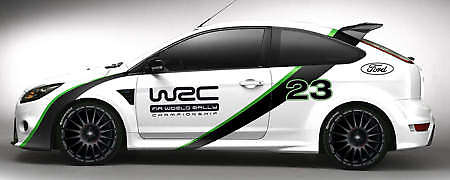
The Ford Focus RS is one hot looking hot hatch and Ford of Switzerland has raised the temperature further with this special version called “WRC Edition”. It will be produced in a limited run of 50 units to commemorate the 40th anniversary of Ford’s RS division.


The WRC Edition, which pays tribute to the legendary Escort RS1600 that was launched in 1970, was designed with the help of Swiss fans who participated in a design competition. The winning design’s base is a “Frozen White” paint finish contrasted by black and green stickers and stripes as well as the 19-inch OZ Superturismo GT multispoke alloys in black. As with all special editions, there’s a plaque and this one bears the signatures of Ford WRC drivers Mikko Hirvonen and Jarmo Lehtinen.


No changes under the bonnet, so the 305 bhp 2.5-litre turbocharged inline-five sprints to 100 km/h in under 6 seconds and on to a top speed of 263 km/h. It is priced at 55,900 francs or about 37,950 euros. Check out some of the proposals that didn’t make it after the jump.

Tuesday, January 19, 2010

2010 Ford Fusion Sport AWD Car Gallery

2010 Ford Fusion Sport AWD Front View2010 Ford Fusion Sport AWD Front View

2010 Ford Fusion Sport AWD Engine2010 Ford Fusion Sport AWD Engine

2010 Ford Fusion Sport AWD Interior2010 Ford Fusion Sport AWD Interior

2010 Ford Fusion Sport AWD Side View2010 Ford Fusion Sport AWD Side View

2010 Ford Fusion Sport AWD Rear View2010 Ford Fusion Sport AWD Rear View

Monday, January 18, 2010

2011 Ford Mustang GT

2011 Ford Mustang GT

Ford thought that by simply plunking a "5.0" badge on the flanks of its 2011 Mustang GT it was going to breathe new life into the less-and-less iconic muscle car — and it was right! The new V8 engine (all 302 cubic inches of it) pumps out a remarkable 412 horsepower and 390 lb-ft of torque while still returning an impressive 25 mpg on the highway. And it looks absolutely gorgeous nestled in the engine bay. Things get even better if you're a gearhead — you can now have real toys like Brembo brakes and sportier suspension.

2011 Ford Mustang GT

Sunday, January 17, 2010

2012 Ford Focus

2012 Ford Focus

The latest movement in Ford's effort to move European products stateside is the 2012 Focus. And like most sheet metal designed by Ford Europe, the Focus looks like it's going to sell by the caseload. The car will be available in both 4- and 5-door guise, and sources say that either one should return around 40 mpg highway. Power is provided by a 2.0-liter direct-injection 4-cylinder engine, which produces 155 horsepower and 145 lb-ft of torque and can be paired with either a 6-speed manual transmission or a 6-speed dual-clutch gearbox.

<a href="http://video.msn.com/?mkt=en-us&amp;from=cp_en-us_autos_videos&amp;fg=MSNautos_perry%20test%202&amp;vid=19747998-4a46-4f16-995d-78eff0e51537" target="_new" title="2012 Ford Focus">Video: 2012 Ford Focus</a>